
The Hidden Cost of Poor Communication at Work
Poor communication isn't just about information being missed.
It's about the mental effort people spend trying to work out what they're supposed to do.
It can mean so much more than missed emails, crossed wires and mistakes. Poor communication has a wider human impact, leaving people feeling overwhelmed, full of self-doubt, lacking in confidence and unsupported at work.
Often staff are blamed, but it could be because the communication simply isn’t clear enough for all.
For a long while I believed the problem was me…
I Thought the Problem Was Me
“Look at them in the eye, then maybe you won’t forget.” I used to say to myself. “Really focus”
Nope – instructions or information relayed to me verbally will be lost within 5 minutes – probably sooner.
I will concentrate; I will engage and be genuinely interested. An old tutor of mine said I was the most supportive teammate during other trainee teacher presentations, and I looked really invested and enthusiastic.
That’s because I a) was being supportive but also
b) I was trying to remember, to learn and let that learning sink into my memory!
Nope – at the age of 27 it wasn’t working and it still doesn’t work at the age of 45.
During the years as a teacher, I have forgotten work deadlines, important dates, checklists and instructions. I made some huge mistakes.
I used to try and take notes, but I would undoubtedly become distracted. Even if I had a full page of notes, trying to understand them later was nigh on impossible.
At the time, I believed I was disorganised, incapable, scatty and forgetful.
The emotional toll was even worse – my over reliance on colleagues to keep me on task and up to date was embarrassing and compounded the feeling of being incapable at simple tasks.
I was constantly catching up and never able to prepare for future deadlines or events.
Looking back, it wasn’t just me or my ADHD brain – it was actually how the communication was relayed. I know this because during my time at one particular school, when the systems and processes changed, information and communication became clearer and I didn’t struggle as much.
Many people that have studied learning or memory function will have come across the German psychologist Hermann Ebbinghaus who created the Forgetting Curve (see image below).
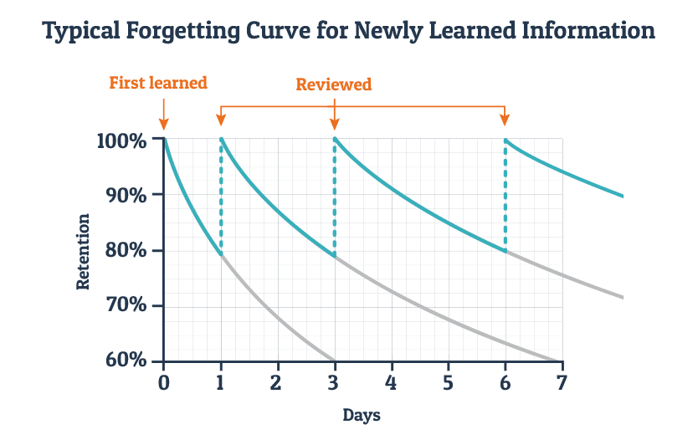
Graph showing how much newly learned knowledge the brain retains and for how long.
Ebbinghaus studied learning, working memory and discovered there were patterns to working memory and retention. His findings showed that unless repeated or revisited, information will be forgotten very quickly by the brain – this is normal.
There are other factors to, such as the complexity of material, how it is presented and how meaningful it is.
For further reading visit Ebbinghaus Forgetting Curve (Definition + Examples) - Practical Psychology
Assumptions Create Confusion
Assuming that everyone understands the information being communicated and is on your wavelength is another issue.
I have ended up at the wrong end of these assumptions.
I was once asked to create a display board with a few key elements included. It was assumed I would know what to do, how to do it and what it should look like. I remember sitting in the meeting as everyone around me was busy designing and creating and I felt so stupid.
In the end I asked for help, which wasn’t a big deal for the senior leader at all but for me it was massive.
The problem wasn’t a lack of effort.
The problem was a lack of clarity.
How often do workplaces assume people know what good looks like?
How often are expectations left unsaid?
How often do organisations assume everyone interprets instructions the same way?
I’ve mentioned WAGOLLS before but they were a game changer for education. It stands forWhat a Good One Looks Like.
Examples, templates and clear expected outcomes really support staff and help clarify details, meanings and expectations.
You don’t need to look far when researching workplace statistics around communication to find some damming evidence. Simon and Simon put together 20 statistics around communication in the workplace and despite communication being a top skill employers look for in candidates, it seems communication has a long way to go in the workplace.
Business & Workplace Communication Statistics 2025 | Simon & Simon
The Confidence Cost
In my experience, communication doesn't just affect performance.
It eats away at confidence.
I’ve sat in many meetings where information hadn’t been communicated clearly enough.
In the early days of my career I would ask questions, to be met with:
· raised eyebrows
· sighs
· sarcastic toned answers
· suggestions that I hadn’t been paying attention
· the fact that no one else asked questions
Slowly, my confidence disappeared, and I learnt that no-one asks questions, they just try and figure it out after the meeting.
In actual fact lots of people didn’t understand but they weren’t confident enough to challenge the poor communication for fear of judgement.
Thank goodness for the one boss who repeatedly used to say, “There is no such thing as a stupid question.”
Poor Communication Doesn't Stay At Work
I draw upon my career in teaching for examples, but I’ve heard lots of examples of poor communication from friends, family and colleagues.
I know someone who was recently successful in applying for a particular office role, only to find out after starting, that the role included many tasks that weren’t properly communicated during the interview and onboarding process.
As a result, they left.
When expectations aren't clearly communicated, people can feel misled, frustrated and disengaged.
I’m sure many of us know someone who is doing work beyond role expectations, taking on workloads that they understood to be in the remit of senior members of staff. Responsibilities of tasks may have become blurred.
If there is a lack of clarity around ownership of duties, the trust and engagement of staff can suffer as well as relationships between colleagues.
This will always end in stress for the employee and businesses run the risk of losing staff unnecessarily.
The Hidden Cost To Businesses
Communication is a top skill, sought after by employers.
Communication in the workplace is also a top priority of employees.
Good communication in a workplace can have a positive effect on:
· productivity
· well-being
· engagement
· retention
· confidence
· a sense of belonging
· motivation
· job satisfaction
And at the end of the day a better financial return.
Potential consequences for not making communication a priority in the workplace can lead to:
· mistakes
· duplicated work
· slower onboarding
· wasted time
· frustrated employees
· reduced confidence
· disengagement
· staff turnover
Most of these costs are hidden.
They don't appear on a spreadsheet.
But they affect performance every day.
What Helps?
Here are some things that helped me:
written follow-up emails
clear examples
templates
checklists
opportunities to ask questions without judgement – even at another time or via email.
clear expectations and timelines
avoiding assumptions
These aren't just ADHD/neurodiverse-friendly practices.
They're clarity-friendly practices for all.
Think about your own workplace:
Are expectations genuinely clear?
Do people know what good looks like?
Are assumptions being made?
Can employees safely ask questions?
Final Thoughts
Looking back, many of the communication challenges I experienced weren't really about communication at all.
They were about clarity.
Poor communication isn’t just about information being missed - it's about the affect on people and the potential consequences it has on their lives, wellbeing and mental health.
Before assuming people aren't listening, aren't organised or aren't capable, it might be worth asking whether expectations have been made clear for everyone, in the first place.
Is the communication a barrier?
Can you remember an example of great or rubbish communication in the workplace?
